
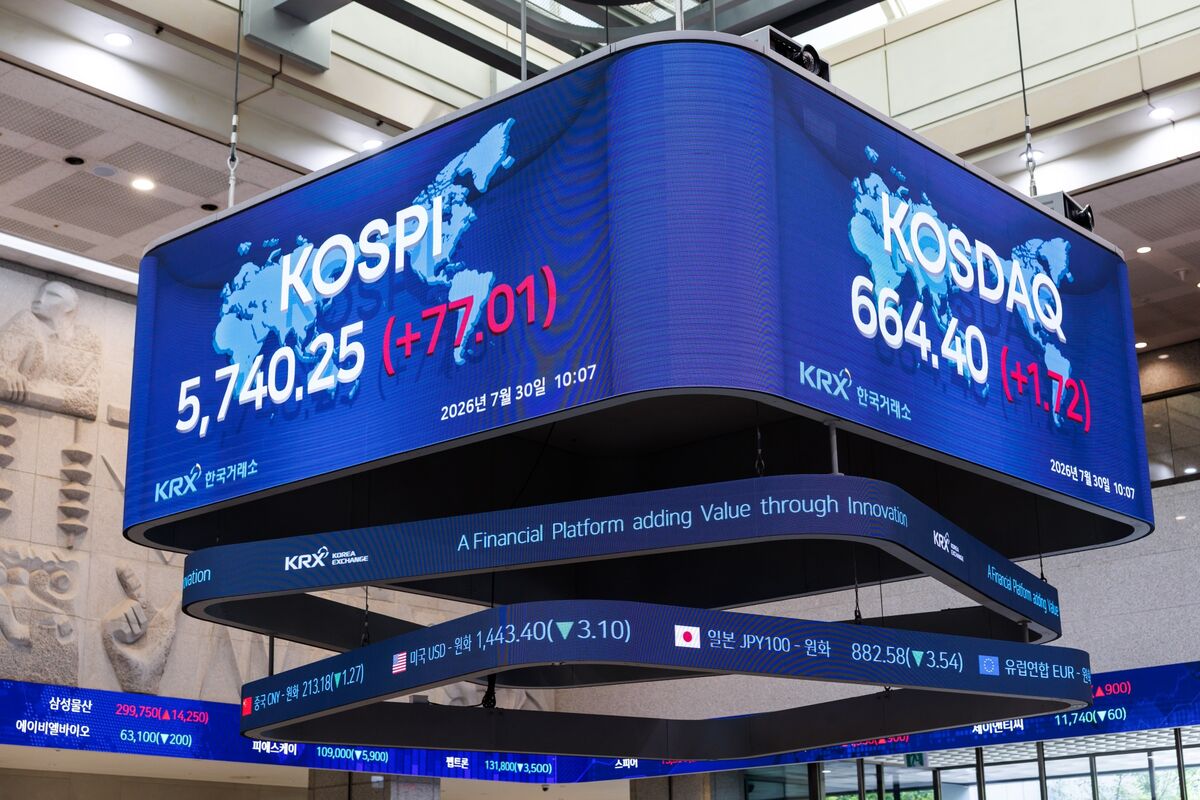
Goldman Sachs Group Inc. strategists have slashed their 12-month target for South Korea's Kospi Index by 25%, to 9,000 from 12,000, as concerns over the artificial intelligence trade intensify. Analysts including Timothy Moe cited more conservative valuation assumptions after the benchmark plunged more than 35% from its June peak. Even after the cut, the revised forecast implies an upside of more than 60% from current levels, and the strategists said the selloff has left equities highly undervalued.
Goldman last raised its Kospi target in June and kept it at 12,000 even as the index's stocks slumped in a global AI selloff that began later that month. Chipmaking giants Samsung Electronics Co. and SK Hynix Inc. have made the Kospi a bellwether for the AI trade. Investors have grown worried about the sustainability of massive infrastructure spending and rising financing costs in the sector, with little sign of sufficient returns. The selling pressure has spread into the broader Korean market.
"The market is pricing an overly negative fundamental outlook," the strategists wrote in a note dated Oct. 25. South Korea has moved from the year's hottest major market to the world's cheapest, with valuations falling to roughly half of Indonesia's. The Kospi's 12-month forward price-to-earnings ratio has fallen to about four, a level last seen in 2006 across any of the 18 markets Bloomberg tracks, after the index started 2026 with a value over $1 trillion.
Goldman estimates current semiconductor valuations imply a 65% decline in the sector's 2027 earnings, a scenario it considers excessively pessimistic. Stocks outside the memory sector, which account for about half the index, trade at 7.6 times forward earnings. Despite the cut, the bank continues to favor power, industrials, corporate governance-related stocks and companies benefiting from domestic reflation and Korean popular culture.
Source: Bloomberg Markets · Summarized by HeadlinesBriefing