
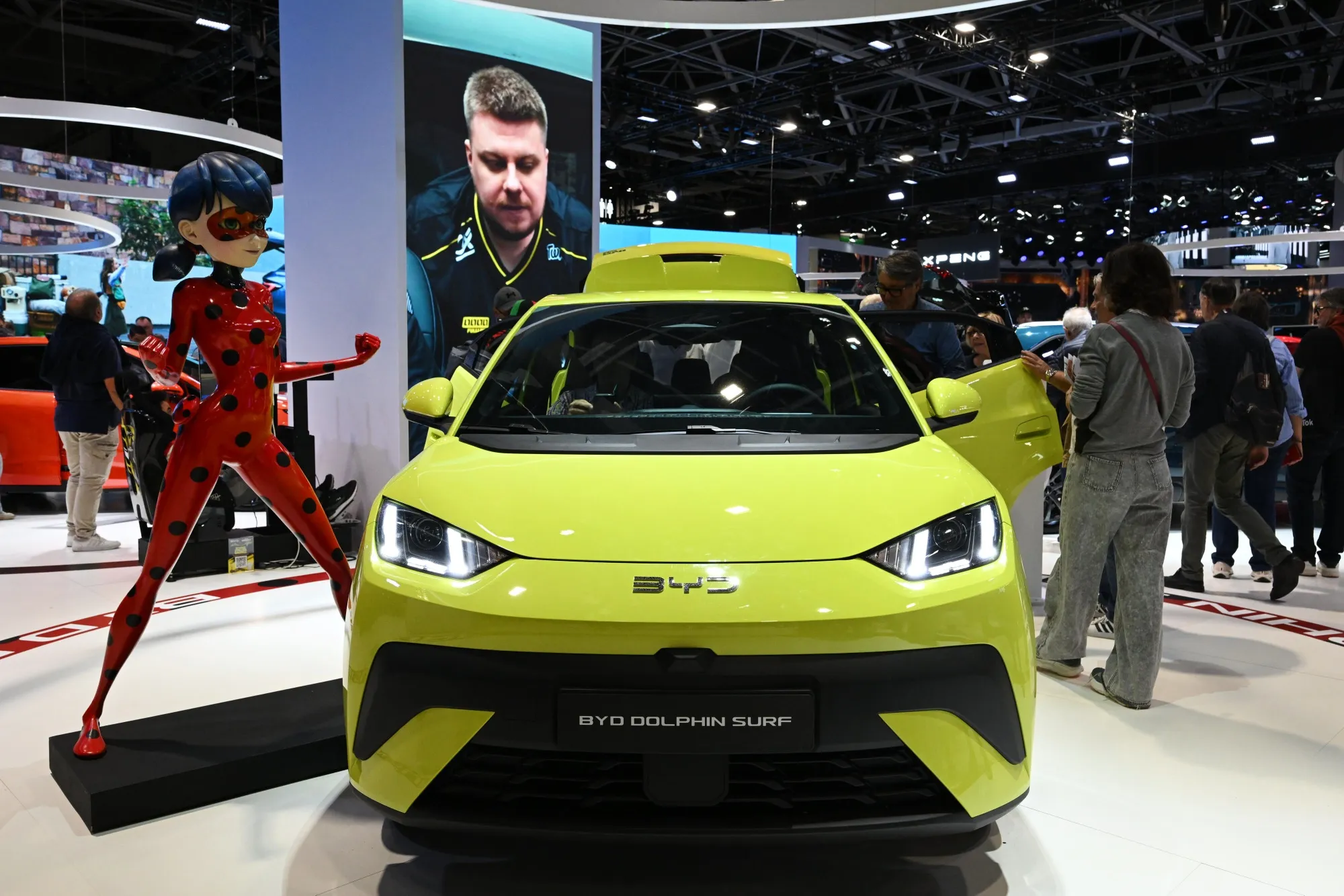
When Lee Seongdong decided to replace his 2016 Chevrolet Spark in April, a two-year wait for Hyundai Motor Co.'s Casper Electric was already pushing him toward BYD Co.'s Dolphin. He was so impressed by the feature-rich ride that he signed a contract on the spot. The Dolphin hatchback starts at 24.5 million won ($18,500), and after discounts Lee paid less than 23 million won, similar to a subsidized Casper Electric, which can be bought at about 22 million won in Seoul but only in its bare-bones trim. Combined with a delivery time shorter than South Korea's mandatory military service, the 47-year-old YouTuber said the BYD was "way too good to pass up."
Lee's purchase reflects a broader shift as BYD brings its low-cost strategy, already winning market share in Europe, to price-sensitive buyers in South Korea. Bloomberg Intelligence data shows a ninefold jump in BYD's EV and hybrid sales from January to August to almost 18,000 units, while Hyundai's comparable sales fell 6% to about 139,000. BYD's September registrations hit 20,000, double its initial goal for the year, according to Korea Automobile & Mobility Association data. The company has overtaken Volvo and Toyota Motor Corp. among foreign carmakers in Korea, despite entering the passenger car market only in early 2025 and losing access to government subsidies in July.
The growth poses a risk to local heavyweights Hyundai Motor Co. and Kia Corp., which still hold a combined 72% share of the domestic market but are struggling to compete with BYD's lower-priced, technology-focused models. Samsung Securities Co. analyst Esther Yim expects Hyundai's annual global sales to fall below 4 million units for the first time since 2010, excluding the 2020 pandemic slump, missing its 4.16 million target. "The biggest driver of their slowdown is Chinese competition," Yim wrote.
Chinese automakers are accelerating into Korea, with BYD's Sealion 6 DM-i plug-in hybrid priced at 37.5 million won, the cheapest in its segment. Analysts say Chinese brands still face hurdles, including sparse service infrastructure, high repair costs and swift depreciation. BYD plans to expand its South Korea service locations to 26 from 20 by year-end, but its low-price strategy will ultimately be tested against Hyundai and Kia's network of more than 1,200 service centers.
Source: Bloomberg Markets · Summarized by HeadlinesBriefing