
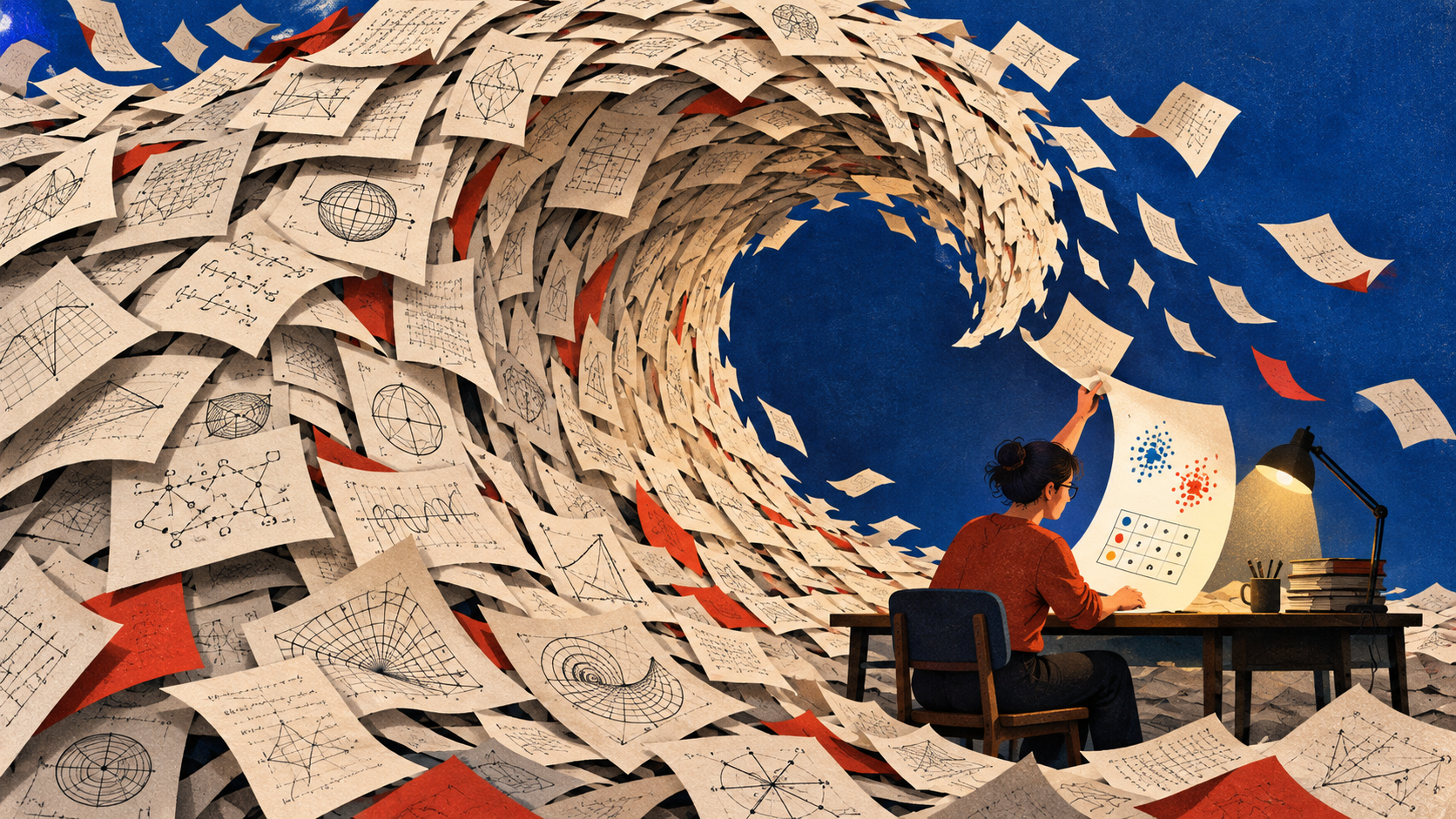
Scott Aaronson compares the mood in mathematics after OpenAI's release to a hunter-gatherer discovering a resort next door, forced to rethink his career. The analogy captures how researchers are reacting to the vast new collection OpenAI published on 6 October 2026, produced by an unreleased internal model.
The collection contains 719 papers grouped into 372 families of related results, spanning seventeen disciplines. Theoretical computer science has the most families, with 40, while probability and statistical mechanics holds the largest share of pages: 29 families containing 7,232 pages, about 21% of the total. The complete catalogue runs to 34,669 pages, and the median paper is 39 pages long. Reading one PDF a day would take almost two years.
For data science, several results target familiar problems. Edit distance, the minimum number of single-character changes needed to turn one string into another, helps match customer records with slightly different spellings such as "Jon Smith" and "John Smyth." The standard exact calculation becomes costly as text grows, since the work scales with the product of the two lengths. The new paper claims a randomized method whose average work grows almost in proportion to the total text length, with an estimate within a set percentage error allowance at least two times out of three.
A proof, however, is not a tool. The author notes that a theorem can establish that a better method is possible long before anyone builds an implementation worth using. Turning these results into practical software will require careful attention to accuracy, distance and randomness, since those choices determine the computation, storage and data required.
Source: Towards Data Science · Summarized by HeadlinesBriefing