
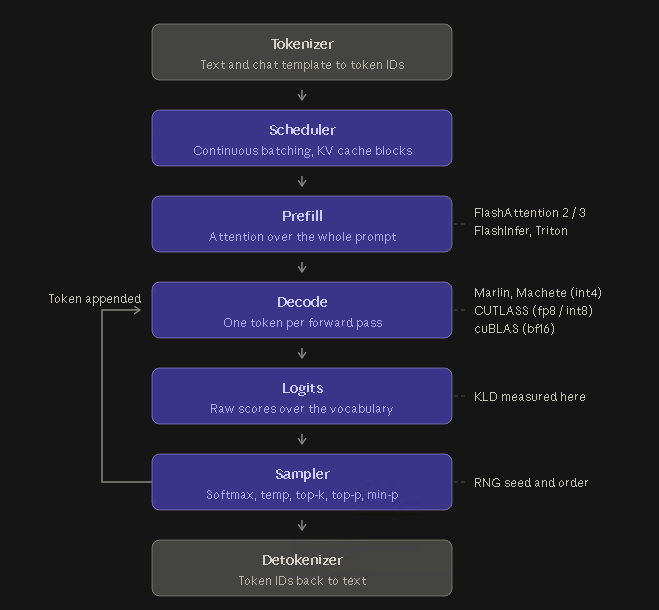
We’ve all downloaded an “AMAZEBALLZ” model only to find your local setup runs poorly. This stems from implementation-specific hazards during inference. The reference lab’s hardware and software differ vastly from yours. Every GPU generation calculates next tokens differently, meaning your home lab naturally diverges from published claims.
To measure how much your setup sucks, run standard benchmarks like terminal bench, hle, SWEthis, HELLAthat, or MMLU-whatever. Skip zero-shot tests; agentic tasks need long-context tool-calling. Match sampler settings exactly. As @wendell noted, math is math. Use the model card’s defaults: usually temp 1.0 and top-p 0.95. Wrong temps cause loops, while mismatched samplers shift probabilities enough to make output feel off.
For a mathematical view, track KLD (KL Divergence). Convert logits to probability distributions and measure drift from a baseline. Lower KLD means closer alignment, not higher intelligence. Beware of impossibly low scores on quantized HF models without disclosed reference checkpoints. Don’t get suckered by low scores without full runtime environments. Run representative tests, match chat templates, and accept that every instance running an LLM today is a little different.
Source: Hacker News · Summarized by HeadlinesBriefing