
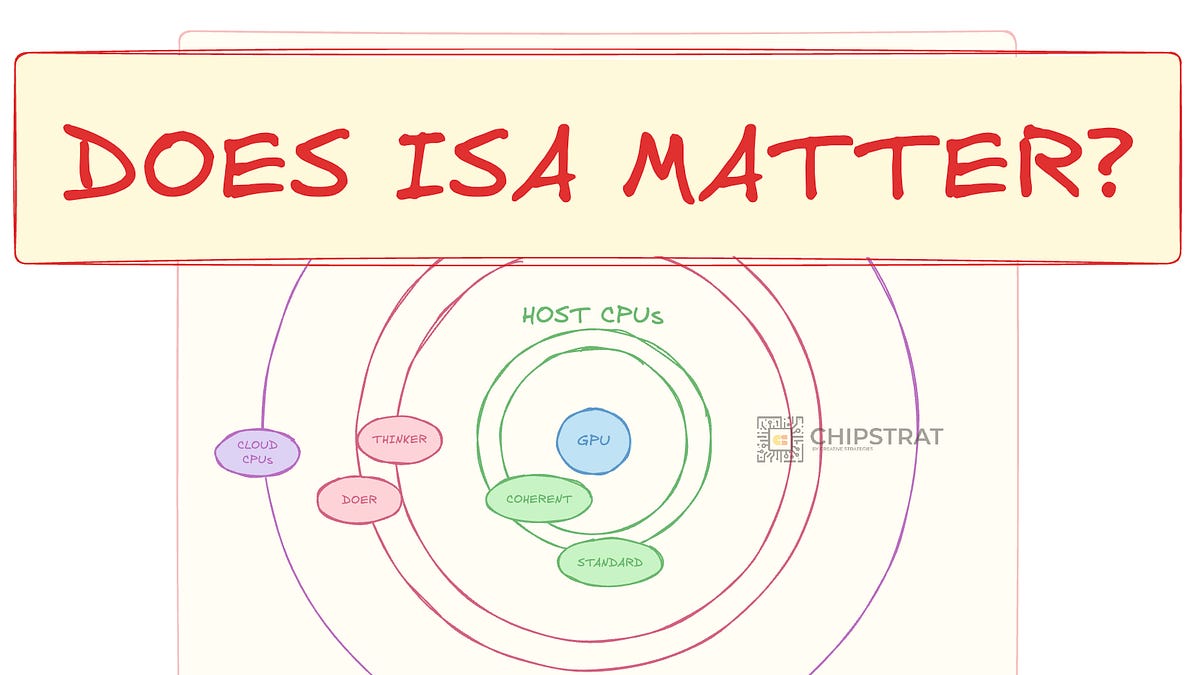
AMD, Intel, Nvidia, Arm, and Qualcomm are competing for datacenter CPU share in the AI buildout. The coherent host socket, connected directly to GPUs via high-bandwidth links, represents the most valuable segment. Here, the ISA debate between x86 and Arm matters less than the coherent connection itself. NVLink-C2C connects Nvidia's Grace CPU to Blackwell GPUs at 900 GB/s, while AMD's Infinity Fabric ties EPYC to Instinct MI455X comparably. The real moat is the GPU connection, not the instruction set architecture.
Nvidia's Grace Hopper superchip debuted the full datacenter CUDA stack on Arm in 2023, marking a shift from standard x86 hosts connected over PCIe. Grace Blackwell and upcoming Vera Rubin extend this with custom Arm CPUs and 1.8 TB/s bandwidth. AMD remains x86-native through ROCm, but NVLink Fusion could change that by opening the coherent-host socket to third-party CPUs including Qualcomm's Arm, Intel's x86, and SiFive's RISC-V.
For standard hosts feeding GPUs, software runs interchangeably on x86 or Arm. AWS pairs Graviton with Trainium, Google uses Axion with TPUs. However, in smaller deployments where hosts run dual duty with application workloads, legacy x86 dependencies resurface and ISA becomes relevant. Enterprises running DGX or Instinct MI355X servers often face this constraint.
The analysis reveals that ISA differentiation is minimal for pure AI infrastructure roles. The coherent link bandwidth and GPU vendor partnerships create the real competitive moats, while software portability across architectures continues improving.