
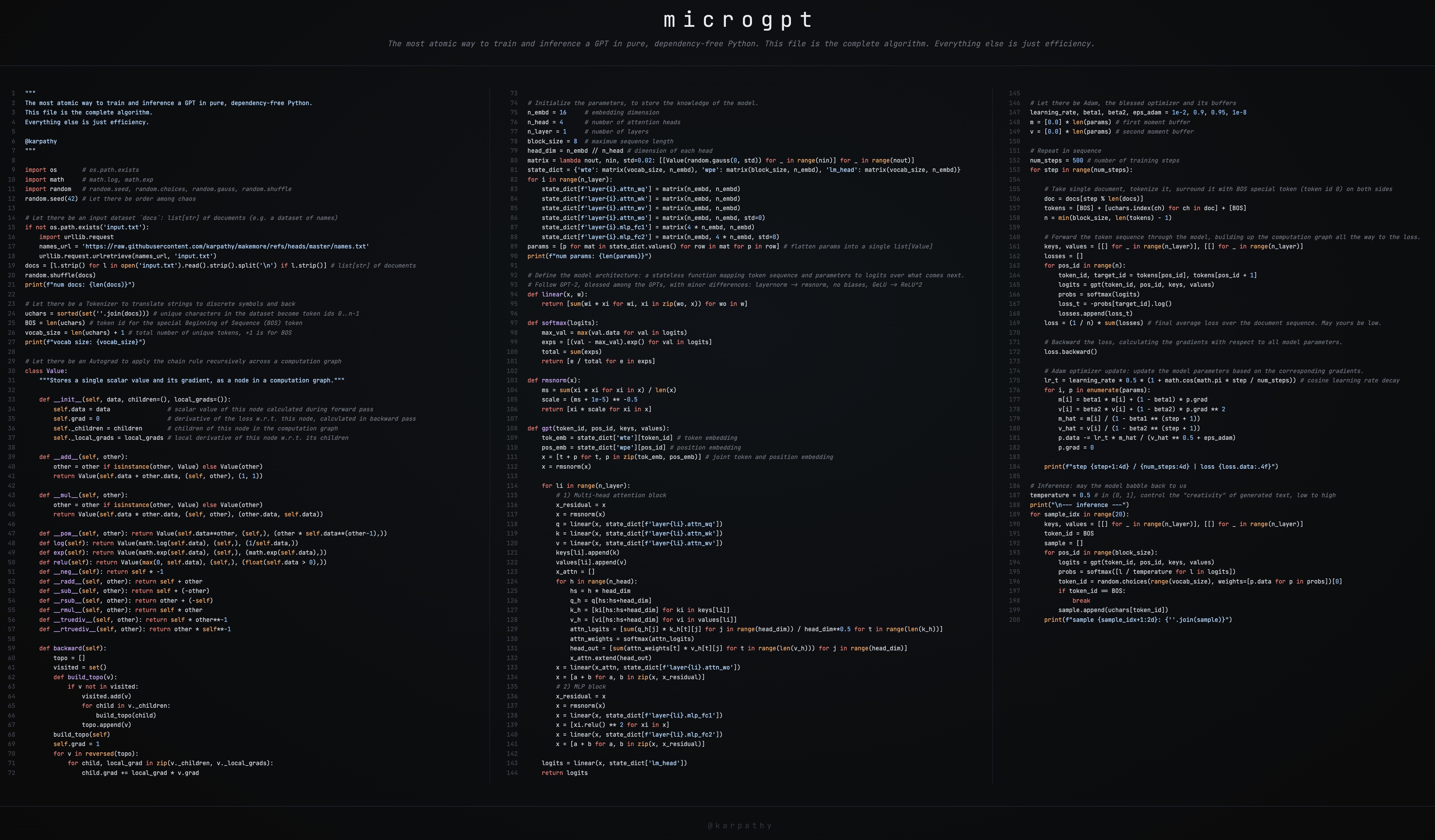
Microgpt, a minimalist Python project by Andrej Karpathy, condenses a functional GPT-like model into 200 lines of code with no dependencies. The GitHub gist (linked in the source) reveals a self-contained implementation covering dataset handling, tokenizer logic, autograd mechanics, and training/inference loops. This stripped-down approach strips away efficiency optimizations to expose core LLM principles.
Built atop Karpathy’s decade-long exploration of machine learning fundamentals, the project merges concepts from micrograd (autograd library) and nanogpt. The dataset—a list of 32,000 names—serves as training material, with each name treated as an independent "document." A basic tokenizer maps characters to integers, creating a 27-token vocabulary (26 letters + a BOS token for sequence boundaries). During training, documents are wrapped as [BOS, text, BOS], teaching the model to recognize document starts and ends.
The Value class powers autograd functionality, tracking computation graphs and gradients through operator overloading. Each mathematical operation (addition, multiplication, etc.) records input dependencies and local derivatives, enabling backpropagation via topological sorting. This manual implementation demystifies how frameworks like PyTorch handle gradient calculations.
By distilling LLMs to their algorithmic essence, Microgpt offers an educational blueprint for understanding neural networks. It transforms abstract concepts—like tokenization and backpropagation—into tangible code, making it ideal for developers seeking to grasp the mechanics behind modern AI systems.
Source: Hacker News · Summarized by HeadlinesBriefing