
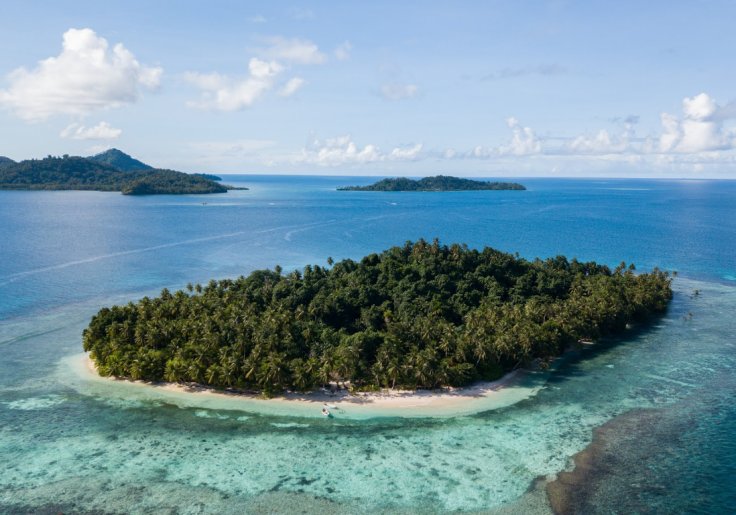
Sofia Santos solved a challenge of identifying a resort on an island using geometry and CUDA programming instead of Google Lens. The image had no useful metadata, so she built a fingerprint by analyzing three landmasses visible in the photo, estimating their relative distances and angles. Using Open Street Map's land polygon dataset (882 MB), she applied heuristic filters: tropical latitude bounds reduced candidates from millions to 141,131, local density filtering dropped them to 51,576, and clustering further narrowed to 23,500 clusters. Generating triplets from clusters produced 80,690,777 combinations, which were processed on an NVIDIA GeForce RTX 3050 GPU. Each triple was assigned to a CUDA thread that computed matching geometry in parallel, taking only 204.1 ms. After deduplication and an open water rectangle test, 948 candidates remained. A final coral cay shape check using Polsby Popper score evaluated compactness of the resort islet.
The approach combined computational geometry with GPU acceleration to efficiently search global coastline data. Rather than relying on image recognition tools, the solution used mathematical analysis of perspective relationships between visible landmasses. The CUDA implementation processed millions of triangle combinations simultaneously, with threads independently computing angle ratios and distance metrics against the fingerprint values. Atomic counters ensured thread-safe result collection, demonstrating effective parallel algorithm design.
Heuristics played a crucial role in managing the massive search space. Filters based on tropical latitudes, local island density, and minimum cluster sizes dramatically reduced computational load before expensive geometric comparisons. The stratified sampling approach for large clusters balanced thoroughness with performance, capping combinations while maintaining representative coverage of different island sizes.
Final verification included both geometric matching and environmental context. The open rectangle test ensured candidates matched the photo's unobstructed water view, while the Polsby Popper compactness score validated that the resort islet resembled a typical coral cay formation.
Source: Hacker News · Summarized by HeadlinesBriefing