
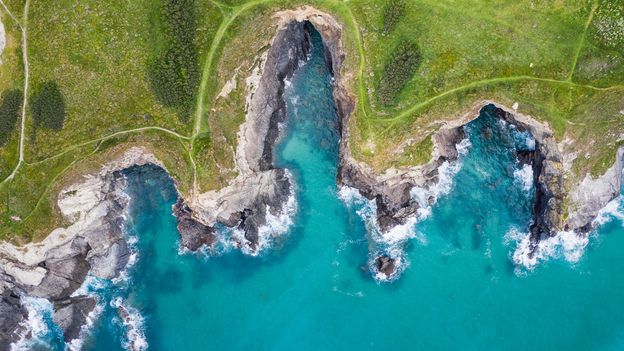
King Charles III inaugurated a new coastal path, but England’s shoreline length defies exact measurement due to the coastline paradox. The 2,689-mile trail connects Cornwall to Northumberland, yet no consensus exists on the UK’s true coastline length. The CIA lists it at 7,723 miles, while the World Resources Institute claims 12,251 miles—a 4,500-mile gap. This contradiction stems from how borders are measured: smaller rulers capture more curves, inflating totals.
The paradox, discovered by Quaker mathematician Lewis Fry Richardson in 1921, reveals that coastlines theoretically approach infinity as measurement scales shrink. Danny Hyam of Ordnance Survey demonstrated this by showing Britain’s coastline lengthening from 10,347 miles at 1:1M scale to over 17,715 miles at 1:2.5K. Tidal variations and geopolitical disputes further complicate matters. For instance, Alaska’s border disputes in the 19th century arose from differing ruler sizes, while India recently added 3,500km to its coastline using finer-resolution tools.
Organizations like NOAA face criticism for inconsistent U.S. coastline reports—ranging from 12,380 to 95,471 miles. Standardization fails due to tidal dependencies and scale subjectivity. As Hyam notes, measuring every barnacle would yield endless results. The paradox isn’t just academic; it impacts sovereignty, resource allocation, and environmental planning. Until a universal standard emerges, coastline lengths will remain fluid, shaped by the tools and priorities of those measuring them.
Source: Hacker News · Summarized by HeadlinesBriefing