
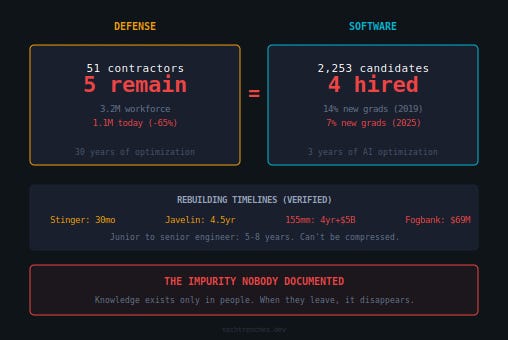
Raytheon’s 2023 Paris Air Show speech revealed a stark truth: the U.S. could not restart Stinger missile production faster than a generation of engineers had retired. Fifty‑plus‑year‑old schematics and idle test rigs stalled a supply chain that suddenly mattered when Russia invaded Ukraine.
The Pentagon had not purchased a new Stinger in two decades, yet the war forced a scramble. An order from May 2022 promised delivery in 2026—a four‑year lag rooted not in cash, but in a vanished knowledge base. Engineers from the 1970s were the only ones who could rebuild the seeker and electronics for the new wave.
Similar bottlenecks plagued European shell production. A 2023 EU pledge of one million artillery rounds collapsed against a 230,000‑per‑year capacity, delivering only half on schedule. France halted propellant manufacturing in 2007; Poland’s sole TNT plant, and Denmark’s Nammo facility lay dormant until 2020. These single points of failure exposed a defense industry built for custom, not mass.
The pattern mirrors software, where AI copilots promise speed but the real bottleneck shifts to human review and decision‑making. A recent randomized trial showed seasoned developers using AI took 19% longer on open‑source tasks than expected. As hiring slows, the scarcity of engineers who can interrogate and own AI outputs may prove the Achilles’ heel.
Source: Hacker News · Summarized by HeadlinesBriefing