
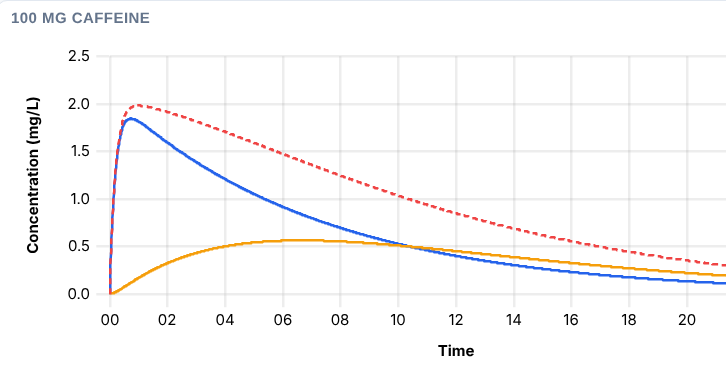
Caffeine's half-life misconception challenged The effects of caffeine consumption persist longer than the commonly cited ~5-hour half-life suggests. Research reveals caffeine is largely metabolized into paraxanthine, a compound with comparable adenosine receptor-blocking affinity. Over 80% of caffeine converts to paraxanthine, which itself has a 3-5 hour half-life, creating a prolonged stimulant effect. This dual metabolic pathway challenges traditional pharmacokinetic models that treat caffeine's decline as a simple exponential decay.
Paraxanthine's unique properties Paraxanthine supplements, now available via brands like Enfinity, offer faster offset effects than caffeine. Users report 100mg paraxanthine providing similar morning alertness to 1-2 cups of coffee, while 200mg exceeds caffeine's potency. The compound peaks within 30-45 minutes but avoids late-day sleep disruption when taken before 7pm. Notably, paraxanthine's shorter half-life stems from lacking active downstream metabolites, unlike caffeine's prolonged residual effects.
Potency debate unresolved Laboratory studies suggest paraxanthine binds to A1 and A2A adenosine receptors with 1.5-2x caffeine's affinity, though human-specific data remains limited. This discrepancy between measured potency and subjective user experiences raises questions about receptor dynamics in vivo versus assay conditions. The findings prompt re-evaluation of both compounds' roles in cognitive enhancement protocols.
Practical implications emerge These metabolic differences explain why paraxanthine supplements market themselves as "cleaner" stimulants. With reduced tolerance development from shorter active periods, they may suit users seeking flexible dosing. However, ongoing research is needed to standardize dosing guidelines and confirm long-term safety profiles for this emerging nootropic class.
Source: Hacker News · Summarized by HeadlinesBriefing