
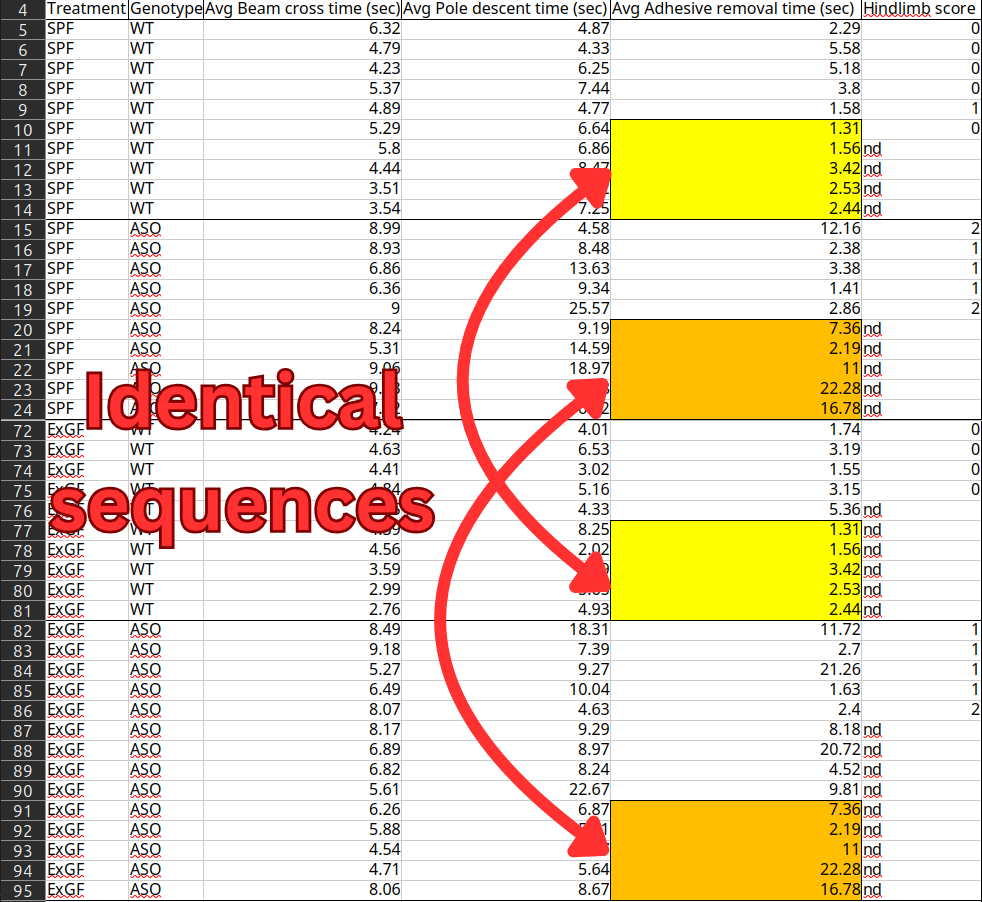
A software tool designed to detect copy-paste errors in scientific datasets has uncovered serious data integrity issues in a landmark Parkinson's disease paper. The 2016 Cell study, which claimed gut microbiota regulate motor deficits in Parkinson's models, has received over 3000 citations and major media coverage. Yet the underlying data on Dryad contains duplicated sequences that shouldn't exist.
Researchers found two sets of five identical sequential numbers in adhesive removal times shared between SPF and ExGF mice groups, plus three identical pole-descent times for germ-free wild-type mice. These duplications represent 50% of SPF samples and 42% of ExGF samples. The study's low sample size makes these errors particularly damaging to its conclusions about gut bacteria causing Parkinson's-like symptoms.
This discovery came from software developed after high-profile data fabrication cases in Thomas Südhof's lab and Jonathan Pruitt's research. The tool scanned 600 datasets, flagging 18 serious cases. While the Parkinson's authors haven't responded to January reports, other flagged papers include an ostrich-snake mixup in cardiotonic steroid research and scrambled fish size measurements in personality studies. These findings raise questions about data verification practices in scientific publishing.
Source: Hacker News · Summarized by HeadlinesBriefing